Recondition Your Golf Cart Batteries Before You Spend $800–$1,500 on a New Set
A full set of Trojan 6V or 8V golf cart batteries costs $800 to $2,000 installed in the United States in 2026. Most golf cart owners in Florida, Arizona, The Villages, and Peachtree City don't need to pay it. Here's what thousands of American golf cart owners do instead.
Quick Answer — Can You Recondition Golf Cart Batteries?
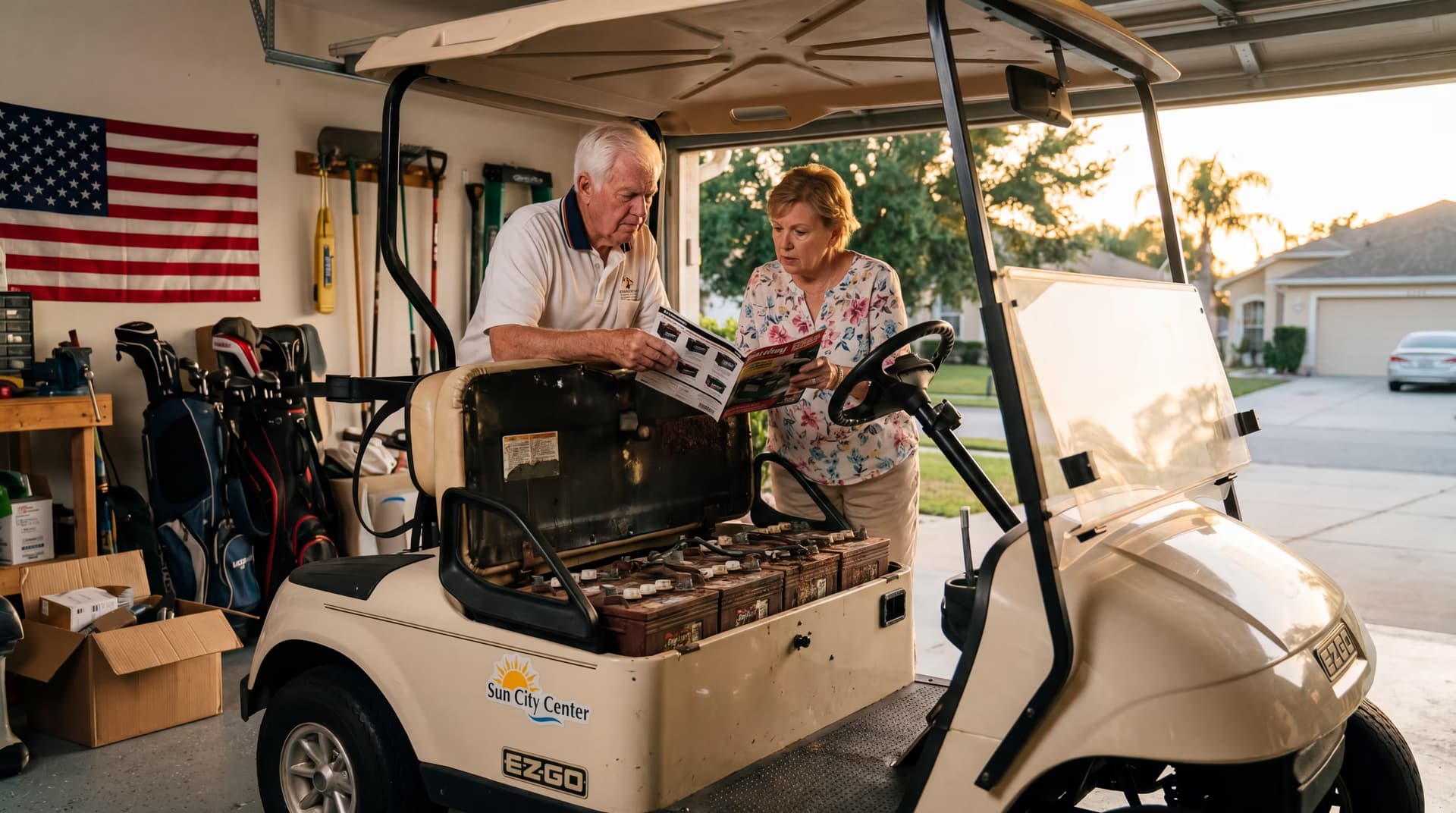
Yes — in most cases. Golf cart batteries are flooded lead-acid deep cycle batteries (6V, 8V, or 12V). They fail primarily due to sulfation — the same process that kills car batteries, but accelerated by deep discharge cycles and seasonal storage. If the battery pack reads above 50% of rated voltage and shows no physical damage, reconditioning through controlled charge-discharge cycles and electrolyte restoration can recover 60–85% of original capacity — enough for full rounds of golf and neighborhood driving across the United States.
$800–$2K
Full pack replacement cost USA 2026
$10–20
Cost to recondition at home
16,000+
Golf courses across the United States
60–85%
Capacity restored with reconditioning
In This Guide
The Numbers That Hurt
What Golf Cart Battery Replacement Really Costs in the USA (2026)
Before deciding to replace, every American golf cart owner needs to see the real numbers. These are verified 2026 prices from dealers and retailers across the United States.
* Prices include battery set + installation. Source: Canyon Lake Mobile Golf Cart Repair, Trojan Battery, Walmart 2026.
The question every golf cart owner in America should ask first:
Are your batteries actually dead — or are they sulfated? A set of 6V golf cart batteries that struggles to complete 18 holes is almost always suffering from deep sulfation and water loss. That is a fixable condition. A full reconditioning cycle costs $10–20 in supplies versus $800–$2,000 in replacement costs. If the pack still holds above 50% of rated voltage, reconditioning is the first move — always.
Where Golf Cart Owners Are in the USA
The States With the Highest Golf Cart Battery Failure Rates
The United States golf cart market is valued at $894 million in 2026. Florida, Arizona, the Carolinas, and Texas lead the country in golf cart ownership — and in battery failures. Heat is the primary killer in all four states.
Florida
The Villages, Naples, Sarasota, Boca Raton
2–3 yrs
Avg Battery Life
🌡️ Heat
Main Threat
Florida has the highest golf cart density in the United States. The Villages alone has over 80,000 carts. Summer heat above 95°F with high humidity accelerates sulfation and water evaporation dramatically.
Arizona
Scottsdale, Sun City, Peoria, Mesa
2–2.5 yrs
Avg Battery Life
🌡️ Desert Heat
Main Threat
Arizona desert heat consistently hits 110°F+ in summer. Golf cart batteries left in the sun can reach 140°F internal temperature — accelerating water loss and sulfation at extreme rates.
The Carolinas
Myrtle Beach, Hilton Head, Pinehurst
3–4 yrs
Avg Battery Life
💧 Humidity
Main Threat
Coastal humidity accelerates terminal corrosion. Golf resorts in Myrtle Beach and Hilton Head maintain large fleets that cycle batteries hard year-round. Moderate heat still shortens life.
Texas
Austin, San Antonio, Houston, Dallas
2.5–3.5 yrs
Avg Battery Life
🌡️ Heat
Main Threat
Texas summer heat rivals Arizona in intensity. Golf cart use in retirement communities across the Hill Country and DFW area is growing rapidly. Battery demand and failure rates are both high.
California
Palm Springs, Coachella Valley, San Diego
3–4 yrs
Avg Battery Life
🌡️ Heat
Main Threat
Palm Springs and the Coachella Valley combine extreme desert heat with affluent golf culture. Battery life is significantly shorter than in coastal California where temperatures are milder.
Southeast Golf Belt
Georgia, Alabama, Mississippi
3–4 yrs
Avg Battery Life
💧 Heat + Humidity
Main Threat
Augusta, Georgia — home of the Masters — represents the golf culture of the Deep South. Year-round use with high humidity means batteries rarely get a seasonal rest, shortening total lifespan.
Root Causes
Why Golf Cart Batteries Die Early — The Real Reasons
Golf cart batteries are deep cycle batteries — built for repeated full discharge and recharge. They are more robust than car batteries, but they have four specific failure modes that are extremely common across the United States.
Deep Sulfation from Full Discharge
Golf cart batteries are discharged much deeper than car batteries — often to 80% capacity every round. If the cart sits overnight at low charge (common in seasonal climates), hard sulfation begins within 24–48 hours. This is the #1 cause of golf cart battery failure in Florida and Arizona.
Water Loss / Dry Plates
Flooded lead-acid golf cart batteries require distilled water every 2–4 weeks during active use. American golf cart owners who skip this lose electrolyte coverage over the plates — exposing lead to air and causing permanent sulfation damage within weeks.
Seasonal Storage Without Maintenance
Golf cart owners in northern US states who store carts over winter without a maintainer return in spring to severely sulfated packs. A 6-month storage period at partial charge can reduce capacity by 40–60% — sometimes making the pack appear completely dead.
Pack Imbalance — One Bad Cell
In a 6-battery series pack, one weak or shorted battery kills the entire pack's performance. The charger can't distinguish individual cells — it sees the pack as a whole. Identifying and reconditioning (or replacing) the single bad unit saves the other five batteries.
Pack Voltage → Reconditioning Candidate?
Measure total pack voltage with a multimeter after 2hr rest
| Pack | Healthy Voltage | Recondition If Above | Replace If Below |
|---|---|---|---|
| 36V (6×6V) | 37–38.5V | Above 30V | Below 20V |
| 48V (6×8V) | 49–51V | Above 40V | Below 28V |
| 48V (4×12V) | 49–51V | Above 40V | Below 28V |
| 72V (6×12V) | 74–77V | Above 58V | Below 42V |
Step-by-Step Process
How to Recondition Golf Cart Batteries at Home — 7 Steps
This is the process that works on EZGO, Club Car, and Yamaha battery packs across the United States — covering 36V (six 6V) and 48V (six 8V or four 12V) systems. Estimated cost: $10–20. Estimated time: 24–48 hours passive.
Safety First — Gloves, Goggles, and Ventilation
Golf cart batteries contain sulfuric acid and produce hydrogen gas during charging. Work outdoors or in a well-ventilated garage. Wear acid-resistant gloves and safety goggles. Keep open flames and cigarettes away from the battery area. Remove metal jewelry before working.
💡 Baking soda neutralizes battery acid on contact. Keep a box nearby and know where to rinse with water.
Test Each Battery Individually
Remove the batteries from the pack. Test each 6V battery individually — healthy reads 6.2–6.4V at rest. Healthy 8V: 8.2–8.5V. Healthy 12V: 12.6–12.7V. Any battery reading more than 0.5V below spec is the weak link. Mark it. This step identifies whether you have one bad battery or a pack-wide sulfation problem.
💡 In a 36V or 48V pack, often only 1–2 batteries are severely degraded. The others may be fully recoverable.
Check and Top Up Electrolyte Levels
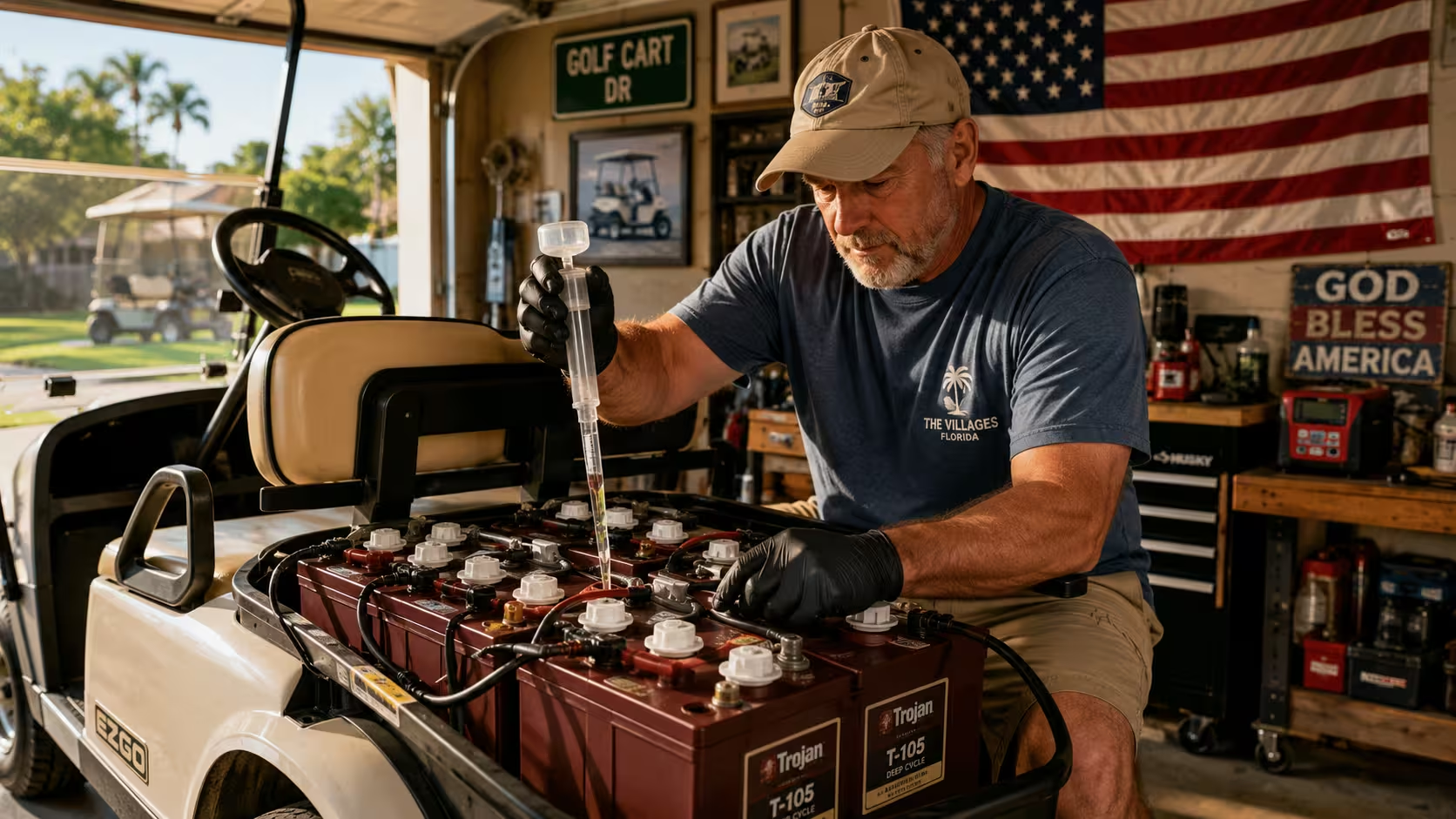
Remove the cell caps on each battery. The electrolyte (sulfuric acid solution) should cover the lead plates by 1/4 to 1/2 inch. If plates are exposed, add distilled water ONLY — never tap water, never acid — until just above the plates. Do not overfill. Overfilling before charging causes overflow and dilutes the electrolyte.
💡 Only add distilled water. Tap water contains minerals that contaminate the electrolyte and accelerate corrosion.
Clean All Terminals and Connections
Mix 1 tablespoon of baking soda in 1 cup of water. Apply to corroded terminals with an old toothbrush. Rinse with clean water and dry thoroughly. Clean battery cables and connection points. Corroded connections add resistance that prevents proper charging — a common hidden cause of poor performance in golf carts across the southern United States.
Slow Charge Each Battery Individually
Using a 6V, 8V, or 12V smart charger (matching the individual battery voltage), charge each battery at the lowest amp setting (2A) for 8–16 hours. This slow charge helps dissolve soft sulfate crystals. A battery that rises above spec voltage and holds it after charging is a confirmed reconditioning candidate.
💡 Never charge all batteries in series for reconditioning — you need individual voltage readings to track each battery's recovery.
Epsom Salt Treatment (Flooded Batteries Only)
For batteries that struggle to rise above 80% voltage after slow charging, mix 1 tablespoon of Epsom salt (magnesium sulfate) in 1 cup of warm distilled water. Add 1–2 oz per cell. Epsom salt reduces electrolyte resistance and supports desulfation. Important: This only works on flooded lead-acid batteries — never on AGM or sealed batteries.
💡 Results vary. Epsom salt works best on moderate sulfation. Severely sulfated batteries may need multiple slow charge cycles first.
Run Full Charge-Discharge Reconditioning Cycles
A proper reconditioning requires 3–5 full charge-discharge cycles. Charge each battery fully (until charger shows complete). Discharge to approximately 50% using a controlled load (a set of lights or a resistive load). Repeat. Each cycle breaks down more lead sulfate crystals and restores plate surface area. After 3–5 cycles, test capacity with a load tester. Most batteries recover to 60–85% of original capacity — enough for full 18-hole rounds.
💡 The complete cycle parameters with exact charge rates, discharge depths, and rest intervals are covered in the free presentation below.
Reconditioning by Cart Brand — EZGO, Club Car & Yamaha
The three brands that dominate the United States golf cart market each use slightly different battery configurations. Here is what you need to know before starting.
E-Z-GO
Common pack: 36V (6×6V) or 48V (6×8V)
Battery type: Flooded lead-acid deep cycle
Replacement cost: $700–$1,600 installed
Recondition tip: EZGO TXT is the most common cart in the USA. Individual battery reconditioning at 6V/8V is straightforward. Check the charger's equalize mode — many EZGO chargers support it.
Club Car
Common pack: 48V (4×12V or 6×8V)
Battery type: Flooded lead-acid; some AGM
Replacement cost: $800–$1,700 installed
Recondition tip: Club Car's aluminum frame is rust-resistant, but 12V configurations mean each battery is larger and heavier. Test individually — the 12V format makes pack imbalance easy to isolate.
Yamaha
Common pack: 48V (6×8V) most common
Battery type: Flooded lead-acid deep cycle
Replacement cost: $900–$1,800 installed
Recondition tip: Yamaha has the longest factory warranty in the industry (4 years) but warranty doesn't cover sulfation. Their 8V batteries respond well to slow-charge reconditioning cycles.
Free PDF: Golf Cart Battery Reconditioning Cheat Sheet
The one-page quick-reference guide for 36V and 48V golf cart owners across the United States. Print it, take it to the garage, and follow the steps.
- ✓Pack voltage diagnostic chart for 36V and 48V systems
- ✓Individual battery test thresholds for 6V, 8V, and 12V
- ✓Epsom salt formula + distilled water ratios by battery size
- ✓Charge cycle parameters for each reconditioning stage
- ✓Red flags that mean replacement — not reconditioning
No spam. Unsubscribe anytime. Sent instantly to your inbox.
In Today's Free Presentation
Thousands of Americans Are Bringing Their Batteries Back to Life
The same reconditioning method works on golf cart batteries, car batteries, deep cycle, AGM, and 20 other types. A battery engineer shares the complete process — free — for drivers and golf cart owners across the United States.
Bring Old Batteries Back to Life
The complete reconditioning method for 6V, 8V, 12V deep cycle and 21 other battery types.
Save Money — Buy Fewer New Batteries
Recondition a full golf cart pack for $10–20 instead of paying $800–$2,000 for replacement.
Used by Golf Cart Owners Worldwide
The reconditioning method is used by cart owners across Florida, Arizona, and in over 180 countries.
Turn Old Batteries Into Profit
Buy dead golf cart batteries cheap, recondition them, sell them for profit — a growing side income for American DIYers.
Free · No credit card · Available now for USA golf cart owners
Frequently Asked Questions
Can you recondition golf cart batteries?
Yes, in most cases. Golf cart batteries are flooded lead-acid deep cycle batteries (6V, 8V, or 12V) that fail primarily due to sulfation and water loss — both reversible conditions. If the battery pack reads above 50% of rated voltage and shows no physical damage (swelling, cracks, or shorted cells), a proper reconditioning process can restore 60–85% of original capacity. This is enough for reliable performance across full rounds of golf and neighborhood driving in communities across the United States.
How much does it cost to recondition golf cart batteries vs replace them?
Reconditioning a full 36V or 48V golf cart battery pack costs $10–20 in supplies (distilled water, Epsom salt, and a smart charger if you don't own one). A replacement set of Trojan 6V batteries for a 36V system costs $700–$1,400 installed in the United States in 2026. A 48V set of Trojan 8V batteries runs $900–$1,700. The math strongly favors trying reconditioning first — especially if the batteries are under 5 years old.
How long do golf cart batteries last?
Well-maintained flooded lead-acid golf cart batteries in the United States last 4–6 years. However, in hot climates like Florida and Arizona, average lifespan drops to 2–3 years due to heat-accelerated sulfation and water evaporation. Batteries that are stored seasonally without a maintainer, or that are repeatedly deep-discharged without prompt recharging, often fail in 2–3 years even in moderate climates.
How do I know if my golf cart batteries need to be replaced or reconditioned?
Test each battery individually with a multimeter. A healthy 6V battery reads 6.2–6.4V at rest; 8V reads 8.2–8.5V; 12V reads 12.6–12.7V. Batteries reading more than 0.5V below spec are degraded. If they rise above spec after slow charging and hold voltage, they are reconditioning candidates. If they drop back to low voltage within 2 hours of removing the charger, or read below 4V (for 6V), a cell is likely shorted — that battery needs replacement.
Does Epsom salt really work for golf cart batteries?
Epsom salt (magnesium sulfate) can help restore flooded lead-acid golf cart batteries with mild to moderate sulfation. It works by reducing electrolyte resistance, which allows the charger to push current more effectively through the sulfated plates. It does not work on AGM or sealed batteries. Results are inconsistent — it works best as a supplement to slow-charge reconditioning cycles, not as a standalone fix.
Can I recondition just one battery in a golf cart pack?
Yes, and this is often the most cost-effective approach. In a series pack, one weak battery pulls down the entire pack's performance. If load testing reveals one battery is significantly weaker than the others, recondition (or replace) just that unit. The remaining batteries may be in good condition and could last another 2–3 years with proper maintenance.
What is the best golf cart battery brand in the USA?
Trojan Battery is the gold standard for golf cart batteries across the United States — particularly the T-105 (6V) and T-875 (8V) models used in EZGO, Club Car, and Yamaha carts. Crown and US Battery are strong alternatives at lower price points. For value, Costco's Interstate batteries are widely praised for their warranty policy. For those considering lithium, LiTime and Dakota Lithium offer direct-to-consumer pricing that undercuts dealer lithium pricing significantly.
How often should you add water to golf cart batteries?
During active use in the United States summer months, check water levels every 2–4 weeks. Only add distilled water — never tap water. The electrolyte should cover the lead plates by 1/4 to 1/2 inch. Add water after charging, not before. Batteries in hot climates like Arizona and Florida lose water significantly faster and may need checking weekly during peak summer use.
Related Battery Guides for American Drivers
Battery Sulfation: What It Is & How to Fix It
The same process that kills golf cart batteries — explained in full.
Complete Battery Reconditioning Guide
The full method for all 24 battery types — car, golf cart, deep cycle, AGM.
How Long Does a Car Battery Last?
Lifespan data by battery type, climate, and driving habit across the USA.
How to Fix a Degraded Battery
Step-by-step guide to reversing battery capacity loss at home.
Fix a Dead Car Battery
The process before you spend money on a replacement.
Battery Not Holding Charge
Diagnose why your battery keeps dying overnight.
Don't Spend $1,500 Until You Watch This
Your Golf Cart Batteries May Have Years of Life Left in Them
The reconditioning method works on 6V, 8V, and 12V deep cycle golf cart batteries — the same types used in EZGO, Club Car, and Yamaha carts across Florida, Arizona, the Carolinas, and every golf cart community in the United States. The free presentation shows the exact process, step by step.
Watch The Free Presentation →Free · No credit card · Available right now for USA golf cart owners