How To Fix A Degraded Battery — What Auto Shops Will Never Tell You
If your battery is slow to crank, drains overnight, or fails to hold a charge — it is most likely degraded, not dead. There is a critical difference, and understanding it could save you hundreds of dollars today.
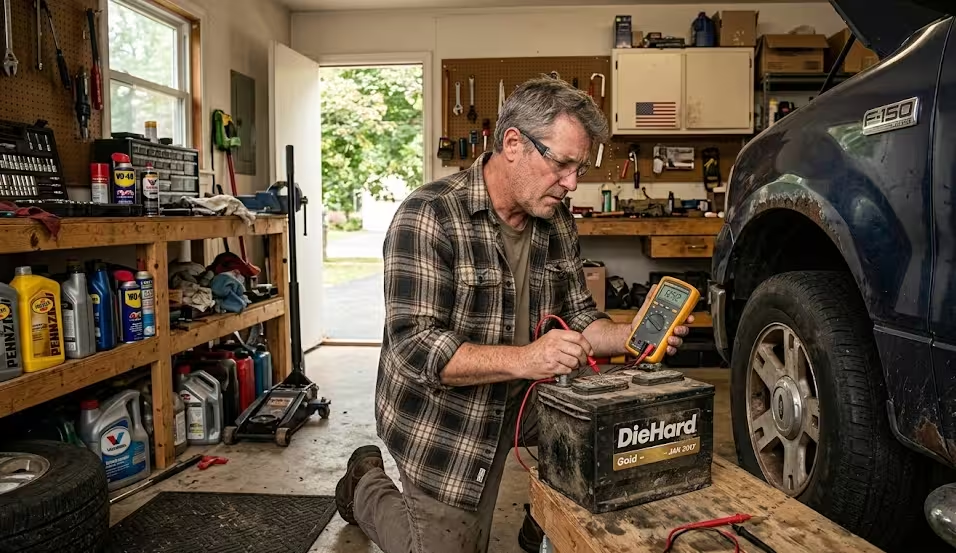
The Uncomfortable Truth About "Dead" Batteries in America
Every year, Americans spend over $3.8 billion replacing car batteries. Billions more on RV, marine, forklift, and golf cart batteries. It is one of the most accepted household expenses in the country.
But here is what most people never find out: the majority of those batteries should never have been thrown away.
Battery degradation — the gradual loss of a battery's ability to store and deliver energy — is not a death sentence. It is a chemical condition. And chemical conditions, in most cases, can be reversed.
The process is called battery reconditioning. It has been practiced by engineers and technicians for decades. But it has remained largely unknown to the average American driver — and battery retailers have every financial incentive to keep it that way.
Before you buy a new battery — ask yourself one question:
Has anyone ever tested your battery for sulfation? If the answer is no, there is a very real chance you are about to spend $200 on a problem that costs $15 to fix.
What Is Battery Degradation? The Science in Plain English
A lead-acid battery operates through an electrochemical reaction between lead plates and a sulfuric acid electrolyte. When the battery discharges, lead sulfate crystals form on the plate surface. When fully recharged, those crystals normally dissolve back into the electrolyte.
Battery degradation begins when this process breaks down. Repeated partial charges, extended periods at low charge, and deep discharges cause the lead sulfate crystals to harden permanently — a process electrochemists call sulfation.
As sulfation progresses, the effective plate surface area shrinks. The battery accepts charge more slowly, holds less energy, delivers lower cranking amps, and heats up faster during use. From the outside, it feels like a dying battery. From the inside, it is a fixable chemical condition.
Additional contributors include electrolyte stratification (acid settling to the cell bottom), plate corrosion from overcharging, and water loss in flooded batteries from heat exposure. Each has a corresponding treatment approach.
Sulfation
Hardened lead sulfate crystal buildup on battery plates. The primary cause of battery degradation in lead-acid batteries.
Electrolyte Stratification
Acid settling to the bottom of the cell, leaving upper plates undercharged. Common in batteries that sit idle for long periods.
Desulfation
The process of breaking down lead sulfate crystals using pulse charging or chemical treatment to restore plate surface area.
State of Health (SOH)
The current capacity of a battery expressed as a percentage of its original rated capacity when new.
Equalization Charge
A controlled overcharge at low amperage that balances individual cells and reverses stratification. Recommended monthly for deep-cycle batteries.
Load Test
A test that measures the battery's ability to deliver current under a realistic load — the most accurate measure of real-world performance.
How To Diagnose a Degraded Battery Before Spending a Dollar
A multimeter costs under $20 at any hardware store and tells you more about your battery's condition than most auto shop tests.
| Resting Voltage | State of Charge | Diagnosis |
|---|---|---|
| 12.7V+ | 100% — Fully charged | Healthy ✅ |
| 12.4–12.6V | 75–100% — Good charge | Monitor |
| 12.0–12.3V | 50–75% — Low charge | Degraded — Recondition |
| 11.0–11.9V | 25–50% — Severely low | Sulfated — Act Now |
| Below 10V | < 25% or shorted cell | Replace ❌ |
* Always test after the battery has rested for at least 2 hours with no load.
Warning Signs Your Battery Is Degraded — Not Dead
Slow engine crank
Engine turns over sluggishly, especially on cold mornings — classic early sulfation sign.
Dimming headlights at idle
Lights weaken when the alternator output is low — battery isn't holding its buffer capacity.
Battery drains in 1–2 days
Sulfated batteries self-discharge far faster than healthy ones, even with no parasitic draw.
Gets hot while charging
Excessive heat during charging indicates high internal resistance — a direct consequence of sulfation.
Reduced accessory run time
Radio, lights, or electronics cut out much sooner than they used to when the engine is off.
Takes hours longer to charge
A sulfated battery accepts current slowly — charge times can double or triple compared to a healthy battery.
How Battery Reconditioning Works: The Process Overview
Battery reconditioning is a multi-step electrochemical restoration process. Here is what each phase accomplishes — and why the exact protocol for each battery type determines whether you get 70% capacity back or 20%.
Voltage Assessment and Candidate Screening
Measure resting voltage with a multimeter after a 2-hour rest. This determines whether the battery has reconditioning potential or has a shorted cell that makes the process unviable.
Terminal and Cell Inspection
Clean corrosion from terminals using a baking soda solution. Inspect for cracks, bulging, or leaks. Physical damage disqualifies the battery from reconditioning.
Controlled Discharge
A full, controlled discharge to approximately 10V prepares the plates for chemical treatment by removing surface charge and exposing the sulfated areas more effectively.
Electrolyte Treatment — Type-Specific
This is where battery type matters critically. Flooded, AGM, gel, and NiCad each require a different treatment approach. Using the wrong method can permanently damage the battery — or produce zero results.
Slow Reconditioning Charge Cycle
A 24–36 hour low-amperage charge using a smart charger with desulfation mode gradually dissolves crystal deposits while monitoring temperature and cell voltage throughout.
Load Test and Capacity Verification
A load test confirms the restored capacity. Successfully reconditioned batteries deliver 70–85% of original capacity — enough for reliable everyday use for months to a year or more.
Here's where most DIY guides stop — and where real results begin
The Steps Above Are the Framework. The Results Come From the Exact Formulas, Voltages, and Timing — Per Battery Type.
Every battery type — lead-acid, AGM, NiCad, gel cell, lithium, forklift, golf cart, marine — requires a specific electrolyte formula, a specific charge profile, and a specific reconditioning sequence. Using the wrong approach on the wrong battery type produces poor results at best, and a dangerous situation at worst.
The method that thousands of Americans are using right now was developed by a battery engineer who spent years testing exact reconditioning protocols for 24 different battery types — and documented the entire system in a format that any homeowner can follow, with no technical background required.
He is currently offering free access to the full presentation that explains how the method works, which batteries it applies to, and what results people across the USA are getting right now.
Watch The Free Presentation NowFree to watch · No credit card required
Which Types of Batteries Can Be Reconditioned?
Battery reconditioning is not limited to car batteries. The same principles — with type-specific modifications — apply across a wide range of battery chemistries common in American homes, garages, and worksites.
Flooded Lead-Acid (Car & Truck)
The most common battery type in the USA. Responds very well to reconditioning when sulfation is mild to moderate. Electrolyte is accessible for treatment.
Reconditioning potential: High — 85% success rate
AGM (Absorbed Glass Mat)
Sealed maintenance-free batteries in modern vehicles and RVs. Require desulfation via smart charger — no cell access for chemical treatment.
Reconditioning potential: Good — requires specific charger mode
Marine & Deep-Cycle
Used in boats, RVs, and solar systems. Prone to deep discharge damage but often excellent reconditioning candidates when the damage is chemical, not physical.
Reconditioning potential: High — designed for cycle use
Golf Cart & Forklift Batteries
Large flooded lead-acid batteries undergoing heavy daily cycling. High commercial reconditioning demand across the USA with significant cost savings.
Reconditioning potential: Very High — major cost savings
NiCad (Nickel-Cadmium)
Common in older power tools and industrial equipment. Suffer from the memory effect. Reconditioning involves full discharge cycling to reset cell capacity.
Reconditioning potential: Good — different process required
Solar & Home Storage Batteries
Off-grid solar systems rely on deep-cycle batteries. Reconditioning these extends the life of entire energy storage systems — one of the highest-value applications.
Reconditioning potential: High — major financial impact
Is Your Battery Worth Reconditioning?
✅ Strong Reconditioning Candidates
- • Resting voltage between 10V and 12.3V
- • Battery is 1 to 4 years old
- • No visible cracks, swelling, or acid leaks
- • Flooded, AGM, or NiCad battery type
- • Still accepts some charge (doesn't stay at 0V)
- • Slow crank or reduced run time — not total failure
❌ Replace — Reconditioning Won't Help
- • Voltage below 10V even after charging attempts
- • Visible cracks, bulging case, or active acid leaks
- • Battery is over 5–6 years old with heavy use
- • One cell stuck below 10.5V (shorted cell)
- • Severely corroded or physically damaged plates
- • Gel battery subjected to over-voltage damage
What Results Can You Realistically Expect?
Batteries with mild to moderate sulfation and no physical damage recover 70–85% of their original rated capacity after a proper reconditioning cycle. For most everyday drivers, that is more than sufficient for reliable daily use.
With proper maintenance and periodic equalization charges, reconditioned batteries routinely deliver 6 to 18 months of additional useful life beyond what would have been a premature replacement.
85%
Success rate for batteries with mild to moderate sulfation
70–85%
Original capacity restored after a proper reconditioning cycle
24 types
Battery types that respond to reconditioning with the right protocol
"I was quoted $280 to replace the battery in my F-150. Decided to look into reconditioning first. After following a proper reconditioning method, the battery passed the load test at 78% capacity. That was 14 months ago. Still running fine."
Marcus T.
Truck owner, Dallas TX
Frequently Asked Questions
How do I know if my battery is degraded or just discharged?
Let the battery rest for at least 2 hours with no load or charger. Then measure voltage with a multimeter. A discharged battery reads below 12.4V but charges back normally. A degraded battery reads low, charges slowly, loses charge quickly, and fails a load test even after a full charge.
How long does the battery reconditioning process take?
The complete cycle — discharge, treatment, and slow charge — takes 24 to 48 hours. Most of that time is hands-off while the charger works. Active preparation steps take 30 to 60 minutes.
Can a completely dead battery be reconditioned?
If the battery reads above 10V and shows no physical damage, reconditioning often helps. Batteries that read 0V or won't rise above 10.5V while charging likely have a shorted cell and cannot be reconditioned. They should be recycled at a hazardous waste facility.
Is battery reconditioning safe to do at home?
Yes, when proper safety measures are followed. Lead-acid batteries produce hydrogen gas and contain sulfuric acid. Always wear rubber gloves and eye protection, work in a well-ventilated area, and keep open flames away. With these precautions, the process has an excellent safety record.
How is reconditioning different from just recharging?
Recharging restores the electrical charge. Reconditioning addresses the root cause — sulfation. It removes crystal deposits from the plates, rebalances the electrolyte, and restores electrochemical activity that recharging alone cannot recover.
Can I recondition an AGM battery?
Yes. AGM batteries cannot have their cells opened for chemical treatment, but they respond well to desulfation and equalization charge modes on smart battery chargers. The process takes longer but is effective for moderate sulfation.
How many times can a battery be reconditioned?
Most lead-acid batteries can be successfully reconditioned two to three times before plate degradation becomes too severe to respond. Each cycle may restore slightly less capacity, but the total service life extension is significant.
Does reconditioning work on lithium-ion batteries?
Lithium-ion batteries degrade differently through lithium-ion loss and dendrite formation rather than sulfation. Some capacity restoration is possible through deep discharge and recharge cycling, but results are less predictable than with lead-acid batteries.
Stop Replacing. Start Restoring.
The Full Method Is Available — For Free
A battery engineer documented the exact reconditioning protocol for 24 battery types in a step-by-step system that any American homeowner can follow — no technical background required. The free presentation shows you exactly how it works, which batteries it applies to, and what real results look like.
Watch The Free Presentation →Free to watch · No credit card · Available right now