How To Restore A Battery Before You Waste $120–$350 on a New One
Across the USA — from Texas to Minnesota, from Phoenix to Chicago — millions of drivers replace batteries that didn't need replacing. The real problem is rarely a dead battery. It's a degraded one. And degraded batteries can often be restored at home for under $15.
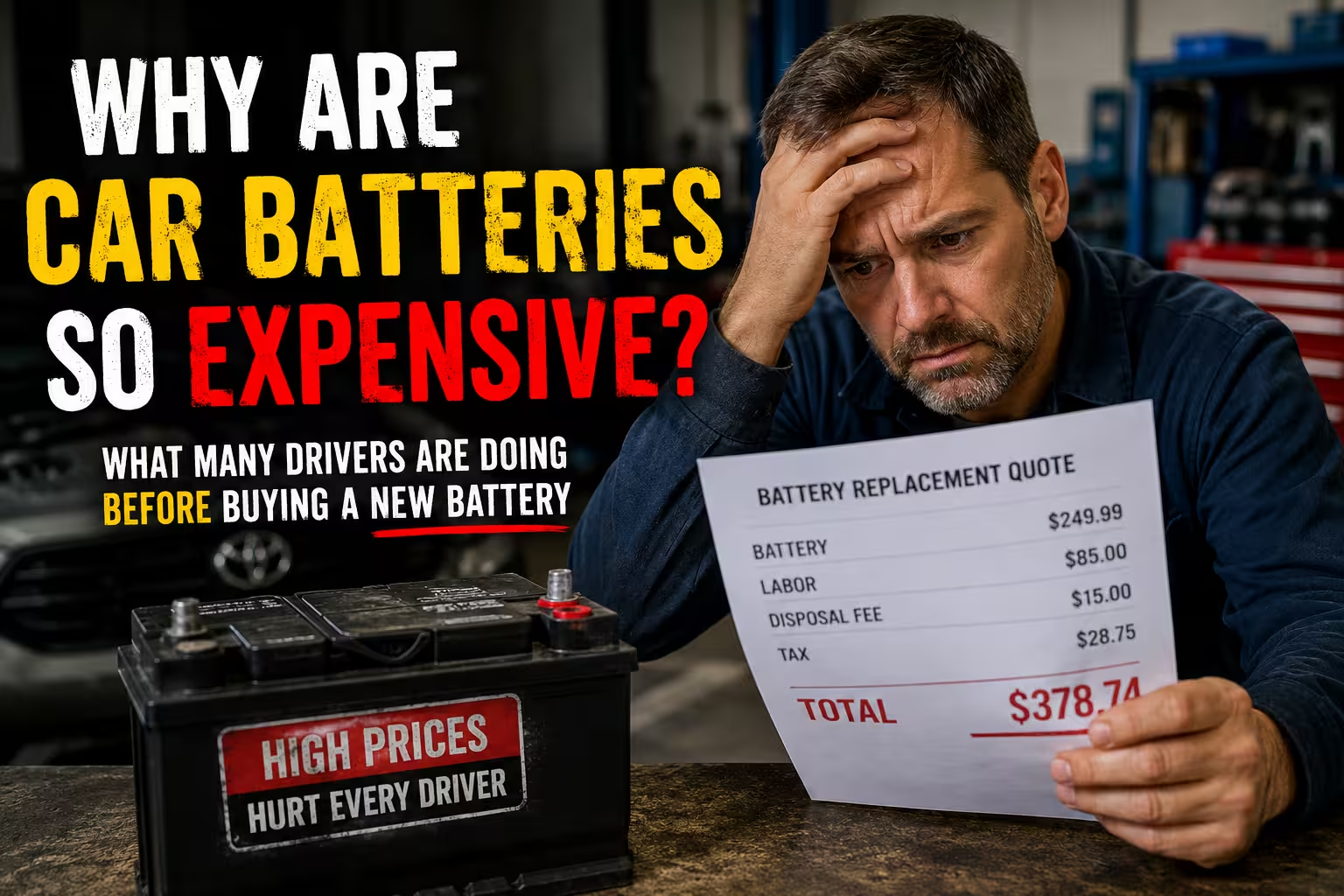
$120–$350
Average car battery replacement cost in the USA
70–85%
Original capacity restored through reconditioning
Under $15
Cost of materials to restore most batteries at home
What Americans Are Actually Paying in 2026
The True Cost of Replacing a Car Battery — By Vehicle and Brand
According to 2025–2026 pricing data from AutoZone, O'Reilly, Walmart, and independent shops, here is what American drivers are actually paying when they say yes to a new battery:
| Battery Type | Common Brands | Cost Installed | Restoration Cost |
|---|---|---|---|
| Standard Flooded (EverStart, SuperStart) | Walmart, AutoZone | $80–$170 installed | ~$15 |
| Mid-tier (DieHard, Duralast Gold, Interstate) | AutoZone, O'Reilly | $120–$220 installed | ~$15 |
| Premium AGM (Optima, Odyssey) | O'Reilly, Advance | $220–$350+ installed | ~$15 |
| Luxury/European AGM (BMW, Mercedes) | Dealership required | $300–$500+ installed | ~$15 |
* Source: AutoZone, O'Reilly, Walmart, and independent shop pricing — 2025–2026
Potential Savings by Vehicle Type
Replacement cost vs. restoration cost at home
Why Your Battery Stopped Working — The Truth Auto Shops Don't Explain
Your car battery is not a light bulb — it does not simply burn out. It degrades through a specific chemical process called sulfation, and that process is almost always reversible if caught in time.
During every charge and discharge cycle, tiny lead sulfate crystals form on the battery plates. Under normal conditions, they dissolve when the battery is fully recharged. But when a battery is repeatedly undercharged — common in American driving patterns with lots of short city trips — those crystals harden and accumulate.
The result: the battery's plates lose effective surface area. It charges slowly, holds less energy, cranks weakly, and drains faster. In Dallas, Phoenix, and Atlanta, summer heat accelerates water evaporation from the electrolyte. In Chicago, Milwaukee, and Minneapolis, winter cold exposes the degradation that summer created.
Here is what auto shops will never tell you: a battery showing those symptoms is not dead. It is sulfated. And according to battery engineers at Renogy and AutoNation's service division, sulfation is reversible in most batteries with mild to moderate wear — restoring 70–85% of original capacity.
Sulfation
The buildup of hardened lead sulfate crystals on battery plates. The root cause of 80%+ of battery degradation in the USA.
Desulfation
The process of breaking down sulfate crystals using controlled charging or chemical treatment — the core of battery restoration.
State of Health (SOH)
Your battery's current capacity as a percentage of its original rated capacity. Restoration targets a 70–85% SOH recovery.
Electrolyte Stratification
Acid settling to the bottom of battery cells, leaving upper plates underperforming. Common in batteries that sit idle.
Cold Cranking Amps (CCA)
The power a battery delivers at 0°F. Restoration directly improves CCA — critical for cold-climate drivers in Chicago, Minneapolis, and Buffalo.
Load Test
The definitive battery health check — measures actual output under real demand. The only true way to confirm successful restoration.
Can Your Battery Be Restored? Check This First
Not every battery responds to restoration. Run this quick check before investing time in the process.
✅ Strong Restoration Candidates
- • Resting voltage above 10V
- • Battery is 1 to 4 years old
- • No cracks, bulging, or active acid leaks
- • Flooded, AGM, or NiCad type
- • Still accepts some charge
- • Slow crank or reduced run time — not complete failure
❌ Replace — Restoration Won't Help
- • Voltage below 10V even after charging
- • Visible cracks, swelling, or acid leaks
- • Battery is over 5–6 years old with heavy use
- • One cell stuck below 10.5V (shorted cell)
- • Won't hold charge more than a few hours
- • Gel battery with over-voltage damage
Quick Voltage Test — What Your Multimeter Is Telling You
| Resting Voltage | Battery State | Action |
|---|---|---|
| 12.7V+ | Fully charged — healthy | ✅ No action needed |
| 12.4–12.6V | 75–99% — slightly low | Recharge soon |
| 12.0–12.3V | Degraded — sulfated | 🔧 Restore now |
| 11.0–11.9V | Severely sulfated | ⚠️ Act immediately |
| Below 10V | Shorted cell or dead | ❌ Replace |
* Test after 2+ hours rest with no load or charger connected
The Restoration Process
How Battery Restoration Works — Phase by Phase
Battery restoration is not a single step — it is an electrochemical process. Here is what happens in each phase and why the sequence matters.
Voltage Assessment — Know What You're Working With
Measure resting voltage after a 2-hour rest with no charger or load. This tells you the battery's state of charge and whether restoration is viable. A reading between 10V and 12.3V means sulfation is present but the battery has restoration potential.
💡 Don't test immediately after charging — surface charge gives falsely high readings.
Terminal Cleaning — Restore Full Electrical Contact
Corroded terminals add 40–60% resistance to electrical flow and can mimic a dead battery. Apply a baking soda and water paste with a wire brush, scrub thoroughly, rinse with distilled water, and dry completely before proceeding.
💡 Sometimes a clean terminal is all a 'dead' battery needs — always do this first.
Controlled Discharge — Prepare the Plates
Discharge to approximately 10V using a low-wattage load such as a 12V automotive bulb. This removes surface charge and prepares the sulfated plate surface for chemical treatment. Never discharge below 10V — it causes irreversible plate damage.
Electrolyte Treatment — The Core of Restoration
This step varies critically by battery type. For flooded batteries, a specific Epsom salt and distilled water solution is added to each cell. AGM batteries require a different approach using smart charger desulfation modes. Using the wrong method on the wrong battery type produces poor results.
💡 This is where the exact formula per battery type makes the difference between 20% and 85% recovery.
Slow Reconditioning Charge — Break Down the Crystals
Charge at the lowest available amperage (2A) for 24–36 hours using a smart charger in reconditioning, desulfation, or equalization mode. Slow charging gradually breaks down sulfate crystal deposits while monitoring temperature. Fast charging at this stage can damage the battery permanently.
Load Test — Confirm the Restoration
After a 2-hour rest, perform a load test to verify real-world capacity under demand. A successfully restored battery delivers 70–85% of its original capacity rating and passes the load test comfortably. If it fails, repeat the reconditioning cycle once before considering replacement.
Here is where most DIY guides stop
The Framework Above Works. The Results Come From the Exact Protocol — Per Battery Type.
Flooded lead-acid, AGM, NiCad, deep-cycle, marine, golf cart, and forklift batteries each require a specific electrolyte formula, charge profile, and sequence. A battery engineer spent years documenting exact protocols for 24 battery types — and is currently offering the complete method in a free presentation.
The same method has been used by drivers in Houston, Denver, Seattle, Nashville, and across the USA to save hundreds of dollars — without visiting an auto shop.
Watch The Free PresentationFree · No credit card required
Which Batteries Can Be Restored? All Major Types Explained
Battery restoration is not limited to car batteries. The same science applies across a wide range of battery types found in American homes, garages, and worksites.
Flooded Lead-Acid
The most common type in the USA — cars, trucks, SUVs. The most responsive to restoration. Cells are accessible for electrolyte treatment.
Savings potential: $80–$220 saved vs. replacement
AGM (Absorbed Glass Mat)
Found in modern vehicles with start-stop systems, luxury cars, and RVs. Requires smart charger with desulfation mode — no cell access needed.
Savings potential: $150–$350+ saved vs. replacement
Marine & Deep-Cycle
Used in boats, RVs, and solar systems. Designed for deep cycling — ideal restoration candidates when damage is chemical, not physical.
Savings potential: $100–$250 saved per battery
Golf Cart & Forklift
Large flooded batteries with heavy daily cycling. High restoration potential. Commercial users save thousands annually by reconditioning fleets instead of replacing.
Savings potential: $400–$1,200 per set
NiCad Power Tool
Nickel-cadmium batteries suffer from memory effect. Restoration through full discharge cycling resets capacity. Saves $30–$80 per battery on tool batteries.
Savings potential: $30–$80 per battery
Solar Storage Batteries
Off-grid solar systems depend on deep-cycle batteries. Restoring these extends the life of the entire storage system — one of the highest-ROI restoration applications.
Savings potential: $200–$800+ per system
Where Battery Restoration Makes the Most Sense in the USA
Geography matters for battery health. American climates punish batteries from both sides — heat in the South and Southwest, freezing cold in the Midwest and Northeast. Both extremes accelerate the sulfation that restoration addresses.
Upper Midwest
Minneapolis, Chicago, Milwaukee, Detroit
Winters below -20°F expose summer sulfation damage. Batteries lose up to 60% power at 0°F. Restoration before winter is critical.
Southwest & Sun Belt
Phoenix, Las Vegas, Dallas, Houston
Summer heat above 100°F accelerates water evaporation from electrolyte and speeds sulfation. Batteries here degrade faster than the national average.
Northeast
Buffalo, Rochester, Boston, Pittsburgh
Lake-effect snow and cold winters. AAA responds to thousands of battery calls here every January. Restoration saves $150–$300 per incident.
Pacific Northwest
Seattle, Portland, Eugene
Short trips in mild weather prevent full alternator recharging. Chronic partial charging causes sulfation even without extreme temperatures.
Southeast
Atlanta, Nashville, Charlotte, Tampa
High humidity combined with heat accelerates terminal corrosion. Restored batteries last longer when terminals are cleaned regularly.
Mountain West
Denver, Colorado Springs, Salt Lake City
High altitude and temperature swings from warm days to cold nights stress batteries year-round. CCA loss at altitude compounds cold-weather degradation.
"Quoted $280 for a new battery on my F-150. Tested it myself — 12.1V. Restored it over a weekend. Still going 16 months later. Saved $265."
Marcus T.
Dallas, TX
"My Camry battery kept dying every winter here in Chicago. Turned out it was sulfated from years of short commutes. Restoration brought it back to full cranking. Game changer."
Jennifer R.
Chicago, IL
"I restore all six batteries on my golf cart fleet instead of replacing them. Saves me about $900 every two years. Once you learn the method, it takes 30 minutes."
David K.
Sarasota, FL
"My BMW X5 AGM battery was quoted at $420 at the dealership. Restored it with a smart charger's desulfation mode. Passed the load test at 78%. Still running."
Sarah M.
Seattle, WA
What Results Can You Realistically Expect?
A restored battery will not perform like a brand-new one — but it doesn't need to. According to data from Renogy and AutoNation's service reports, batteries with mild to moderate sulfation routinely recover 70–85% of original capacity after a proper reconditioning cycle.
For most American drivers, that is more than enough. A battery at 75% capacity starts the car reliably, powers accessories, and handles daily demands without issue — typically for 6 to 18 months of additional useful life beyond what would have been a premature replacement.
The key variable is how early you act. A battery at 12.0V is a much better restoration candidate than one that has been sitting at 10V for weeks. The sooner sulfation is addressed, the more complete the recovery.
70–85%
Original capacity restored in most successful reconditioning cases
$200+
Average savings vs. auto shop replacement across vehicle types
24 types
Battery types covered by the complete reconditioning method
Free Download — No Email List Spam
The Garage Mechanic's 3-Step Battery Diagnostic Cheat Sheet
A printable PDF with the voltage chart, visual inspection checklist, and the "Is It Revivable?" quiz — everything you need to test your battery before spending a dollar at the auto shop.
Free · No spam · Unsubscribe anytime
Frequently Asked Questions
How do I know if my battery can be restored or needs to be replaced?
Test resting voltage after 2 hours with no load or charger. If it reads above 10V and has no physical damage, it is a strong restoration candidate. A battery reading 12.0–12.3V is sulfated — not dead — and typically recovers well. Below 10V or with a shorted cell, replacement is the better choice.
How long does battery restoration take?
The complete process takes 24–48 hours. Terminal cleaning and discharge preparation take about 30–60 minutes. The slow reconditioning charge runs 24–36 hours hands-off. Most of the time is passive while the charger works.
Can I restore an AGM battery at home?
Yes. AGM batteries cannot be opened for electrolyte treatment, but they respond well to smart charger desulfation and equalization modes. The process takes longer but is effective for moderate sulfation. Many modern smart chargers under $50 include an AGM reconditioning setting.
Is restored battery as good as a new one?
Not identical — but 70–85% of original capacity is what most restoration delivers, which is more than sufficient for daily driving. A properly restored battery starts the car reliably, powers all accessories, and typically provides 6–18 months of additional useful life.
How many times can a battery be restored?
Most lead-acid batteries can be successfully reconditioned 2–3 times before plate degradation prevents further recovery. Each cycle may restore slightly less capacity, but the total service life extension is significant compared to premature replacement.
Does restoration work on batteries that have been dead for a long time?
It depends on how long and how deep the discharge was. Batteries that have sat at very low voltage for weeks can develop permanent hard sulfation that resists reconditioning. Batteries that have been discharged but not left sitting for extended periods respond much better. The sooner you act, the higher the recovery rate.
What is the difference between restoration and reconditioning?
The terms are used interchangeably. Both refer to the process of reversing sulfation and restoring electrochemical activity to degraded battery plates — distinct from simply recharging, which only restores the electrical charge without addressing the underlying chemical degradation.
Don't Replace It Until You Watch This
The Full Battery Restoration Method Is Available — Free
A battery engineer developed the complete step-by-step restoration protocol for 24 battery types. The free presentation shows exactly how it works — and why thousands of American drivers use it instead of paying the auto shop.
Watch The Free Presentation →Free to watch · No credit card · Available right now