Your Car Battery Dies in Cold Weather Because of This — Not Because It's Dead
At 32°F your battery loses 35% of its power. At 0°F it loses 60%. AAA responds to over 4 million cold-weather battery calls every winter in the USA — and most of those batteries did not need to be replaced.
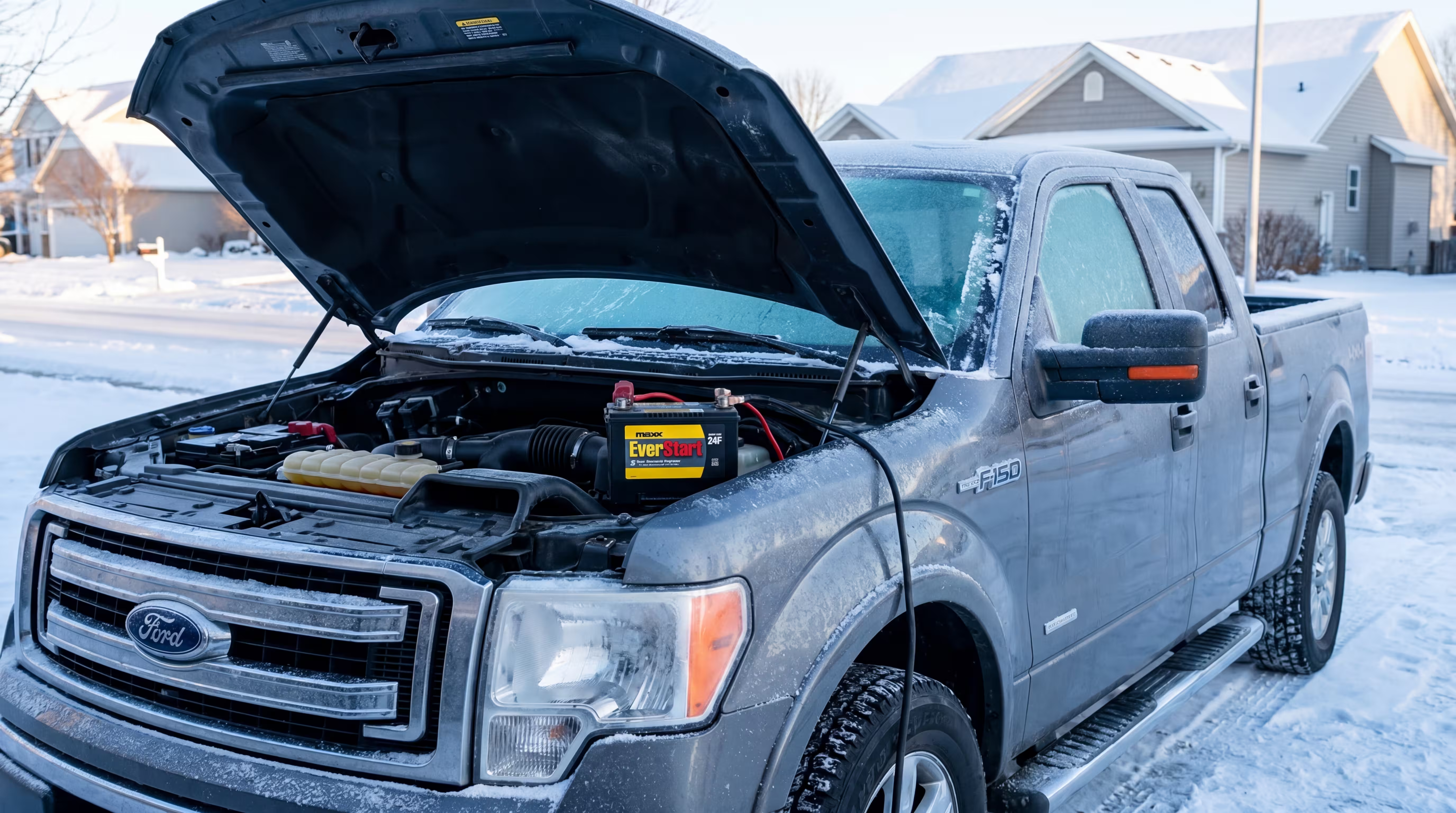
Real data from AAA Automotive Research Center
At 0°F — Your Battery Is Already at 40% Power
4M+
AAA cold-weather battery calls per year
35%
Battery power lost at 32°F
60%
Battery power lost at 0°F
The Science Behind Cold Battery Death
Why Cold Weather Kills Car Batteries — The Real Explanation
Your car battery generates electricity through a chemical reaction between lead plates and sulfuric acid. That reaction is temperature-dependent — and cold weather slows it dramatically.
At the same time, cold engine oil becomes thicker and harder to pump, forcing your starter motor to work much harder to turn the engine over. This creates what AAA calls a "double-whammy" — your battery delivers less power precisely when your engine demands more of it.
According to AAA's Automotive Research Center, a car engine needs about 30% more energy to start at freezing temperatures. And at 0°F, your battery can only deliver 50% of its rated capacity. If your battery was already slightly degraded heading into winter, that combination is enough to leave you stranded.
The critical insight most drivers miss:
A battery that reads 12.0–12.3V in fall is already degraded — running at about 50% charge. Add a 0°F morning and it has effectively zero reserve. That battery is not dead. It is degraded and cold-stressed. Those are two very different problems with very different solutions.
Most Affected Cities
If You Live in These Cities, Your Battery Is at High Risk Every Winter
These are the 12 most battery-punishing cities in the USA — ranked by average winter temperature and days below freezing per season.
Minneapolis / St. Paul
Minnesota
18.7°F
Avg Winter Temp
58 days
Days Below 32°F
Coldest major city in the USA. Record low: -41°F. Batteries here face the harshest conditions in the country.
Chicago
Illinois
26.4°F
Avg Winter Temp
45 days
Days Below 32°F
Wind chill off Lake Michigan amplifies the cold. Record: -27°F. AAA responds to thousands of battery calls here every January.
Milwaukee
Wisconsin
24.9°F
Avg Winter Temp
51 days
Days Below 32°F
Lake-effect cold from Lake Michigan. Batteries tested hard from November through March.
Buffalo
New York
27°F
Avg Winter Temp
44 days
Days Below 32°F
Lake Erie lake-effect snow and cold. One of the top 10 coldest cities in the USA.
Detroit
Michigan
27°F
Avg Winter Temp
43 days
Days Below 32°F
Five-month winters with lake-effect snow from Lake Huron. Battery failure is extremely common.
Denver
Colorado
32°F
Avg Winter Temp
155 days
Days Below 32°F
High altitude accelerates heat loss. More days below freezing than almost any other US city.
Cleveland
Ohio
30°F
Avg Winter Temp
42 days
Days Below 32°F
Lake Erie lake-effect and damp cold. Batteries degrade faster in Cleveland than the national average.
Boston
Massachusetts
30°F
Avg Winter Temp
38 days
Days Below 32°F
Nor'easters and Atlantic cold fronts. Ranked 20th coldest major US city.
Pittsburgh
Pennsylvania
32°F
Avg Winter Temp
36 days
Days Below 32°F
Cold valley winters with temperature inversions. Battery failures spike in January and February.
Kansas City
Missouri
33°F
Avg Winter Temp
34 days
Days Below 32°F
Arctic air from the Great Plains funnels straight into Kansas City every winter.
Indianapolis
Indiana
30°F
Avg Winter Temp
40 days
Days Below 32°F
Midwest cold with little protection from Arctic fronts. Battery service calls spike every December.
Rochester
New York
27°F
Avg Winter Temp
44 days
Days Below 32°F
One of the snowiest cities in the USA. Cold-weather battery stress is a yearly reality for residents.
What Actually Happens to Your Battery Over Winter
Most battery failures in winter don't happen suddenly. They build over months through a process that starts in summer — when high temperatures accelerate internal corrosion and water evaporation from the electrolyte.
By the time fall arrives, the battery has already lost capacity. It charges fine, starts the car, and gives no warning signs. Then the first serious cold snap hits and the reduced chemical reaction rate exposes the degradation that was already there.
This is why winter is when batteries die but summer is when they get damaged. The double season cycle — heat damage followed by cold exposure — is responsible for the majority of unexpected battery failures across the USA.
The Typical Battery Failure Timeline
Summer (June–August)
High temperatures accelerate sulfation and water evaporation from the electrolyte. Your battery silently loses capacity — often 10–20% — with no visible warning signs.
Early Fall (September–October)
Battery charges and starts the car normally. No symptoms. The degradation is hidden because temperatures are mild and engine demand is low.
Late Fall (November)
First cold mornings. Slow cranking begins. Many drivers ignore it or attribute it to the cold. Battery is actually now at 60–70% of original capacity.
Winter (December–February)
First serious cold snap. Battery cannot deliver enough current to start the engine. Driver is stranded. Auto shop replaces it — often unnecessarily.
What To Do Right Now
Your Car Won't Start on a Cold Morning — Do This First
Before calling AAA, before driving to the auto shop, before spending $200 — run through these steps in order.
Try a Jump Start First
A cold-stressed battery often responds to a jump start. If the car starts and runs normally after jumping, the battery has power — it was just too cold to deliver it. Drive for at least 30 minutes to let the alternator recharge it fully.
💡 If it won't jump-start at all, or if it jumps but dies again within hours, move to step 2.
Bring the Battery Inside to Warm Up
A battery at 0°F that has been brought to room temperature (70°F) can recover 20–30% of its power without any treatment. If you can safely remove the battery, bring it indoors for 2–4 hours before testing or charging.
💡 Never use a heat gun or direct heat source on a battery. Room temperature only.
Test Resting Voltage with a Multimeter
Once the battery is at room temperature, let it rest for 2 hours and test voltage. 12.4V or above = still has charge and capacity. 12.0–12.3V = degraded and sulfated, not dead. Below 10V = likely shorted cell.
💡 A reading of 12.0–12.3V is actually good news — it means reconditioning can likely restore it.
Slow Charge Before Deciding Anything
Connect a smart charger on the lowest setting (2A) for 8–12 hours. A battery that accepts a slow charge and rises above 12.4V is a strong reconditioning candidate. If it won't hold above 12V after a full slow charge, it has a shorted cell.
💡 Fast charging a cold or sulfated battery can cause dangerous heat buildup. Always use slow charge first.
Consider Reconditioning Before Replacing
If the battery passes the voltage test but keeps failing in cold weather, the root cause is sulfation — not a dead battery. A proper reconditioning cycle can restore 70–85% of original capacity, which is often enough for reliable cold-weather starting.
💡 The full reconditioning method is available in the free presentation below.
If your battery passes the voltage test but keeps failing in cold weather
The Problem Is Sulfation — And It Can Be Reversed
A battery that reads 12.0–12.3V in rest is sulfated — lead sulfate crystals are blocking the chemical reaction. Cold weather exposes this degradation because the reaction rate drops. The battery isn't dead. It needs reconditioning.
A battery engineer developed a step-by-step reconditioning method that works on 24 battery types — including cold-stressed lead-acid and AGM batteries. He is currently offering free access to the complete presentation.
Watch The Free PresentationFree · No credit card required
Cold Cranking Amps — What Your Battery Spec Actually Means
CCA is the number that matters most in winter. It measures how much current your battery can deliver at 0°F for 30 seconds while maintaining at least 7.2 volts.
| Vehicle Type | Recommended CCA | Cold Climate CCA | Risk Level |
|---|---|---|---|
| Small car (Honda Civic, Toyota Corolla) | 400–500 CCA | 550+ CCA | Medium |
| Midsize sedan (Camry, Accord) | 500–600 CCA | 650+ CCA | Medium |
| Full-size truck (F-150, Silverado) | 650–750 CCA | 800+ CCA | High |
| SUV / Minivan | 600–700 CCA | 750+ CCA | High |
| Diesel truck | 800–1000 CCA | 1000+ CCA | Extreme |
| Luxury / European vehicle (AGM) | AGM 60–95Ah | AGM required | High |
* For every 10°F drop below 32°F, your effective CCA decreases approximately 10%
How to Protect Your Battery Before Winter Hits
Test Your Battery Every Fall
AAA recommends annual battery testing starting at age 2 in warm climates, age 4 in cold climates. A 5-minute test before winter can save you from being stranded at -20°F.
Use a Battery Maintainer When Parked
A trickle charger or battery maintainer ($25–$50) keeps your battery at full charge during extended cold parking. Essential for vehicles parked outside in Minneapolis, Chicago, or Buffalo.
Park in a Garage When Possible
A garage at 50°F versus outdoor parking at -10°F makes a massive difference. Even an unheated garage significantly reduces cold-weather battery stress.
Clean Terminals Before Winter
Corroded terminals add 40–60% resistance to electrical flow. A 3-minute cleaning with baking soda paste before the first cold snap can prevent a winter breakdown.
Take Longer Drives Weekly
Short trips don't give the alternator time to fully recharge the battery. A 30-minute highway drive once a week during winter keeps the battery at full charge.
Minimize Electrical Load on Cold Starts
Turn off heated seats, rear defroster, and radio before starting in extreme cold. Give the battery every advantage on those first critical seconds of cranking.
Frequently Asked Questions
Why does my car battery die in cold weather but work fine in summer?
Cold temperatures slow the chemical reaction inside your battery, reducing the power it can deliver. At 32°F a battery loses 35% of its strength. At 0°F it loses 60%. If the battery was already slightly degraded heading into winter, this power reduction is enough to prevent starting. The battery didn't suddenly die — cold weather exposed degradation that was already there.
Can a battery that died in cold weather be saved?
Often yes. Bring the battery to room temperature, let it rest for 2 hours, and test the voltage. If it reads above 10V and has no physical damage, it is likely a reconditioning candidate. A battery that reads 12.0–12.3V is sulfated — not dead — and can often be restored to 70–85% of original capacity through proper reconditioning.
How cold does it have to be to kill a car battery?
Significant power loss begins at 32°F (0°C). At that temperature your battery has 35% less power than at room temperature. The most dangerous range for battery failure is 0°F to -20°F, where power loss reaches 50–65% of rated capacity. For already-degraded batteries, even 20°F can be enough to cause a no-start condition.
Should I replace my battery before winter?
Only if it fails a load test. A voltage reading alone is not enough. Have your battery load-tested by a technician or with a home load tester — it measures actual cranking capacity under real demand. A battery that passes a load test at 70%+ capacity can typically handle another winter, especially with a battery maintainer.
Does cold weather permanently damage a car battery?
Extreme cold alone rarely causes permanent damage to a lead-acid battery. However, allowing a cold-discharged battery to sit at low voltage for extended periods accelerates sulfation, which can cause permanent capacity loss. Recharging promptly after a cold-weather discharge prevents most permanent damage.
What is the best car battery for cold weather in the USA?
Look for the highest Cold Cranking Amps (CCA) rating for your vehicle and climate zone. AGM (Absorbed Glass Mat) batteries outperform standard flooded batteries in cold weather because they maintain higher power output at low temperatures and recharge faster after a cold-weather discharge. For cities like Minneapolis or Chicago, choose a battery with CCA at least 20% above your vehicle's minimum specification.
Related Guides
Don't Replace It Until You Watch This
Your Cold-Stressed Battery May Have Years of Life Left
The free presentation shows exactly how the reconditioning method works on cold-damaged and sulfated batteries — and why thousands of American drivers use it every winter instead of paying the auto shop.
Watch The Free Presentation →Free to watch · No credit card · Available right now