Car Battery Dies in Summer Heat? Don't Replace It Until You Read This
AAA confirmed: summer heat is the #1 battery killer in America — not winter cold. Under-hood temperatures in Texas, Arizona, and Florida exceed 200°F. If your battery dies in the heat, there are 6 possible causes. Only one of them requires a new battery.
1.83M
AAA battery calls in summer 2024 alone
17 months
Shorter lifespan in southern US vs. north — Consumer Reports
200°F
Peak under-hood temp in Texas and Arizona summers
What's Actually Happening Under Your Hood
Why Summer Heat Destroys Car Batteries — The Truth Most Shops Skip
Most American drivers worry about their battery in January. They should be worrying in June. According to Consumer Reports, batteries in the southern United States last an average of 17 months less than in colder northern climates. That's not a small difference — that's nearly a year and a half of lifespan evaporated by heat.
Here is what is happening inside your battery right now, on a Texas afternoon in June: under-hood temperatures exceed 140–200°F. Your battery's ideal operating range is 70–80°F. At 140°F, the electrolyte fluid inside your battery — the water and sulfuric acid mixture that makes the whole thing work — begins evaporating. The lead plates inside become partially exposed. Corrosion accelerates. Lead sulfate crystals — the process called sulfation — form faster than the alternator can reverse them.
Your battery might start your car fine today. But every blazing afternoon is permanently removing capacity you will never get back. And the failure, when it comes, hits without warning — usually in a parking lot, in the heat, far from home.
The scientific rule most drivers never hear:
For every 15°F rise in temperature above 77°F, the rate of battery degradation doubles. A Phoenix June afternoon at 104°F means the air above the asphalt is already 2°F above the threshold — and your under-hood temperature is 40–60°F higher than ambient air. Your battery is degrading at 4–8x the normal rate. Every. Single. Day.
Is Your City on This List?
The American Cities Where Summer Heat Kills Batteries Fastest
Battery lifespan data from AAA and Consumer Reports, ranked by summer heat impact. If you live in one of these cities, your battery is under assault right now.
Phoenix
Arizona
Avg June temp
104°F
Over 100 days per year above 100°F. Under-hood temps regularly hit 160–200°F. Battery lifespan averages 2.5–3 years — the lowest in the continental USA.
Las Vegas
Nevada
Avg June temp
104°F
Desert heat with low humidity accelerates electrolyte evaporation faster than any other major US city. Parking on exposed asphalt adds 20°F to battery temperature.
Dallas / Fort Worth
Texas
Avg June temp
96°F
Stop-and-go I-35 traffic combined with extreme heat creates perfect conditions for sulfation. Short-trip drivers here have the fastest sulfation rate in the USA.
Houston
Texas
Avg June temp
93°F
High humidity prevents engine bay from cooling at night. Under-hood temps regularly exceed 140°F. Battery corrosion accelerates 3x faster than in northern cities.
Tucson
Arizona
Avg June temp
100°F
60°F mornings followed by 105°F afternoons create thermal expansion stress that fractures internal battery components faster than any other climate type.
San Antonio
Texas
Avg June temp
95°F
Extended summer season — heat begins in April and runs through October. Battery degradation accumulates over 7 months with minimal recovery time.
Tampa
Florida
Avg June temp
91°F
Year-round heat with no winter recovery period for batteries. Humidity and salt air accelerate terminal corrosion dramatically. Average battery lifespan: 2.5–3 years.
Miami
Florida
Avg June temp
89°F
Salt air + humidity + year-round heat = the fastest terminal corrosion rate in the USA. Batteries here often fail from corrosion before sulfation gets them.
Atlanta
Georgia
Avg June temp
88°F
AAA responds to thousands of battery calls here every July and August. I-285 stop-and-go traffic in the heat creates chronic undercharging — prime sulfation conditions.
6 Reasons Your Car Battery Dies in Summer Heat — And Which Ones You Can Fix at Home
Heat is the trigger — but the mechanism varies. Diagnosing the right cause is what separates a $15 fix from a $200 replacement you didn't need.
Heat-Accelerated Sulfation — The Silent Killer
Most CommonEvery charge cycle leaves trace amounts of lead sulfate on the battery plates — this is normal. But summer heat dramatically accelerates this process. The crystals harden faster than the alternator can reverse them, especially during short trips where the battery never reaches a full charge. The result: a battery that appears dead but is actually sulfated. Battery University identifies this as the #1 cause of apparent failure in hot climates. This is the exact condition that DIY battery reconditioning is designed to reverse.
How to identify it:
Test resting voltage after a full overnight charge. Reads 12.0–12.3V? That is the sulfation signature. The battery is not dead — it is a candidate for lead acid battery reconditioning.
✅ Can often be restored — battery reconditioning frequently reverses this
Electrolyte Evaporation
Very Common in HeatThe electrolyte inside your battery — a mixture of water and sulfuric acid — begins evaporating significantly above 80°F. In Phoenix or Houston in June, under-hood temperatures can reach 140–200°F. At those temperatures, fluid loss is rapid and ongoing. As the level drops, the lead plates become partially exposed to air, causing irreversible corrosion and accelerating sulfation. On flooded batteries this can be corrected by topping up with distilled water. On sealed AGM batteries, evaporation damage is permanent.
How to identify it:
On flooded batteries: check fluid level through translucent case or under caps. Below the plates = evaporation damage in progress. AGM batteries cannot be checked directly — use voltage and load testing.
✅ Can often be restored — battery reconditioning frequently reverses this
Terminal Corrosion From Heat + Humidity
Extremely CommonHeat accelerates the chemical reactions that cause terminal corrosion — the white, blue, or green powder that forms on battery terminal posts. This corrosion adds 40–60% resistance to electrical flow and can completely prevent the battery from charging or delivering power, even when the battery itself is perfectly healthy. In humid climates like Houston, Tampa, and Miami, terminal corrosion is the single most common cause of apparent battery failure in summer — and the easiest to fix.
How to identify it:
Inspect terminals visually. Any powder or crust = corrosion. Fix: baking soda + water paste + wire brush + rinse + dry. This 5-minute fix resolves a significant percentage of summer battery complaints.
✅ Can often be restored — battery reconditioning frequently reverses this
Heat-Induced Overcharging
CommonHigh under-hood temperatures can interfere with the voltage regulator — the component that controls how much charge the alternator delivers to the battery. When the regulator malfunctions from heat, it can send too much voltage to the battery (above 14.8V), causing overcharging. Overcharging accelerates electrolyte evaporation, boils off battery fluid, and permanently damages internal plates. Unlike sulfation, overcharge damage is typically not reversible through reconditioning.
How to identify it:
With engine running, test battery voltage. 13.7–14.7V = normal charging. Above 14.8V = overcharging — check the voltage regulator and alternator before replacing the battery.
⚠️ This cause typically requires replacement or professional repair
AC Load + Short-Trip Undercharging
Very Common in SummerRunning the air conditioner at maximum in summer heat pulls 15–20 amps from the electrical system — far more than normal. On short trips, the alternator doesn't have time to replace what the AC and starter motor used. The battery slowly drains with each start and never fully recovers. After weeks of short trips in summer AC conditions, a healthy battery can reach sulfation threshold. This is one of the most common summer battery failure patterns for city drivers.
How to identify it:
Track your typical trip length. Under 10 minutes per trip in summer AC conditions = chronic undercharging risk. A $25 battery maintainer plugged in overnight restores what short trips take away.
✅ Can often be restored — battery reconditioning frequently reverses this
Age-Accelerated by Heat
Common After Year 2 in Hot ClimatesA battery rated for 5 years in a temperate climate may last only 2.5–3 years in Phoenix, Dallas, or Tampa. Heat compounds every other form of degradation: it accelerates sulfation, speeds up electrolyte evaporation, increases corrosion, and shortens the number of effective charge cycles. After 3 years in a hot climate, even a battery that passes a voltage check may be running at 50–60% of original capacity — and one hot summer afternoon away from failure.
How to identify it:
Check the battery date code sticker (month/year format on the case). If it's over 2.5 years old in AZ, TX, or FL — or over 3 years in GA, SC, or NV — age-compounded heat damage is likely a factor.
✅ Can often be restored — battery reconditioning frequently reverses this
The Timeline Most Drivers Miss
How Summer Heat Silently Kills Your Battery Over 90 Days
Heat season begins — damage is invisible
Under-hood temperatures start climbing. Electrolyte evaporation begins. Sulfation rate increases slightly. Battery passes every voltage check. No symptoms.
Degradation accelerates — still no warning signs
Daily 95°F+ temperatures mean the battery is degrading at 2–4x the normal rate. Capacity begins dropping measurably. The battery still starts the car. Most drivers have no idea.
Cumulative damage threshold — symptoms appear
After 90+ days of heat exposure, the battery's reserve capacity may be 40–60% of original. Slow cranks on very hot mornings. Hesitation. Dashboard flicker. AAA call volume peaks.
Failure — usually sudden, always in the worst moment
The battery gives out completely. Typically in a parking lot, far from home, in 100°F heat. The damage was done in April. The failure shows up in August.
Winter exposé — heat damage blamed on cold
Heat-weakened batteries frequently fail on the first cold snap of fall. Drivers blame the cold. The cold was just the final demand on a battery the summer already destroyed.
Why most battery failures seem to come out of nowhere:
Heat-damaged batteries often pass a basic voltage check right up until the moment they fail. The damage is in the capacity — the amount of charge the battery can store — not in the resting voltage. A battery at 12.4V can still be running at 40% of its original capacity. The only way to catch this before it strands you is a proper load test — not a quick multimeter check.
Before You Pay Anyone a Dollar
The 4-Step Summer Battery Diagnosis — $15 Multimeter, 10 Minutes
This exact sequence tells you whether your battery needs replacing, reconditioning, or whether the problem is somewhere else entirely. Do this before calling the auto shop.
Resting Voltage — The Foundation Test
Engine off, no charger connected, rest for at least 2 hours. This is the most revealing single data point for a heat-damaged battery.
| 12.7V+ | Fully charged — heat hasn't killed capacity yet | ✅ Healthy |
| 12.4–12.6V | Slightly low — recharge and retest | Monitor |
| 12.0–12.3V | Sulfated from heat — NOT dead — recoverable | 🔧 Recondition |
| Below 10V | Shorted cell — replace | ❌ Replace |
Alternator / Charging System Test
Start engine. Measure voltage at battery terminals with engine running. Confirms whether the alternator is keeping up with summer AC load.
| 13.7–14.7V | Alternator charging normally | ✅ Good |
| Below 13.5V | Undercharging — alternator or heat-damaged regulator | ⚠️ Inspect alt. |
| Above 14.8V | Overcharging — voltage regulator failure from heat | ❌ Check reg. |
Terminal Corrosion Inspection — Free, 60 Seconds
Visually inspect both terminal posts. Summer heat + humidity makes this the fastest-developing battery problem in southern states.
| No buildup | Terminals clean — not the issue | ✅ Clear |
| White/blue powder | Corrosion present — adding 40–60% resistance | 🔧 Clean now |
| Heavy crust | Severe corrosion — may have damaged cable ends | ⚠️ Full clean |
Load Test — The Only True Capacity Test
A load tester applies a realistic current demand (typically 50% of the CCA rating) and measures whether the battery holds voltage above 9.6V. AutoZone and O'Reilly both perform this test free. This is the only test that reveals whether summer heat has permanently reduced the battery's reserve capacity.
| Above 9.6V at load | Battery holding up under real demand | ✅ Passes |
| 9.0–9.5V at load | Marginal — heat has reduced capacity significantly | ⚠️ Recondition |
| Below 9.0V at load | Fails load test — capacity severely degraded | ❌ Replace/recond. |
If Summer Heat Caused Sulfation — Your Battery May Not Be Dead
Sulfation — the hardening of lead sulfate crystals on the battery plates — is the most common outcome of summer heat damage. And it is also the most commonly misdiagnosed as "dead battery." According to Battery University, sulfation is responsible for the majority of apparent battery failures in the USA.
Here is the critical distinction: a sulfated battery reads 12.0–12.3V after a full charge and refuses to hold it. A truly dead battery reads below 10V and cannot be recovered. These two conditions look identical to a driver — the car won't start — but they have completely different solutions.
Battery reconditioning — the process of dissolving lead sulfate crystal buildup and restoring the battery's electrochemical activity — can recover a sulfated battery to 70–85% of original capacity. For a battery that costs $150–$350 to replace, that math is significant.
This is why DIY battery reconditioning, lead acid battery reconditioning, and battery restoration at home have become some of the most-searched automotive topics in the USA — especially in hot-climate states. Drivers in Phoenix, Houston, Dallas, Atlanta, and Tampa are doing this right now, instead of paying the auto shop.
What battery reconditioning actually means
Recondition lead acid battery: The process applies a controlled desulfation charge sequence — specific voltage and current profiles that break down hardened lead sulfate crystals without damaging the plates. This is different from a standard trickle charge.
Restore battery at home: Standard flooded, AGM, deep-cycle, marine, and NiCad batteries each require a different reconditioning formula. Using the wrong protocol on an AGM battery that needs lead acid battery reconditioning will damage it further.
Battery restoration at home requires roughly $10–$15 in materials and a standard battery charger most drivers already own. The process takes 6–12 hours and can add 6–18 months of useful life to a heat-damaged battery.
Reconditioning old batteries works on car batteries, truck batteries, motorcycle batteries, golf cart batteries, forklift batteries, and marine deep-cycle batteries — any lead acid or NiCad chemistry. The core reconditioning principle is the same across all of them.
❌ Auto Shop Route ($150–$350)
- • Pay $150–$350 for a replacement battery
- • Sulfation — the root cause — is not addressed
- • New battery faces the same heat next summer
- • Repeat every 2.5–3 years in Texas, Arizona, Florida
- • Disposal of a perfectly restorable battery
✅ DIY Battery Reconditioning (~$15)
- • Dissolves lead sulfate crystals — fixes the actual problem
- • Restores 70–85% of original capacity
- • Works on car, truck, AGM, deep-cycle, marine, golf cart
- • 6–18 months of additional useful life
- • Learn the protocol once — use it on every battery you own
The battery reconditioning guide most shops don't want you to find
A Battery Engineer Documented the Exact Reconditioning Protocol for 24 Battery Types — Free Access Right Now
Flooded lead acid, AGM, deep-cycle marine, golf cart, forklift, NiCad — each chemistry requires a different reconditioning formula and charge sequence. This engineer spent years testing the exact process for each type and is currently sharing the complete guide at no cost.
If your battery was damaged by summer heat and reads 12.0–12.3V after a full charge, it is not dead. It is sulfated. And there is a documented protocol to restore it this weekend — for under $15.
Watch The Free PresentationFree · No credit card required
7 Things That Actually Protect Your Battery This Summer
AAA and Consumer Reports both confirm that summer battery failures are largely preventable. Here is what the data says actually works.
Park in shade or a garage whenever possible
Parking in direct sun adds 15–20°F to under-hood battery temperature. Over a summer, shaded parking can add months to battery life — especially in Arizona and Texas.
Use a battery maintainer on short-trip vehicles
A $25 trickle maintainer plugged in overnight replaces what short-trip summer AC driving takes away. Prevents the chronic undercharging that accelerates sulfation.
Check and clean terminals monthly in summer
Summer heat and humidity are the worst conditions for terminal corrosion. Baking soda + water + wire brush takes 5 minutes and prevents one of the most common causes of apparent battery failure.
Load test annually — not just a voltage check
Consumer Reports recommends a load test for any battery over 2 years old in a warm climate. Voltage alone won't reveal summer capacity loss. Free at AutoZone and O'Reilly.
Pre-cool the car briefly before blasting AC
Opening windows for 30–60 seconds before starting the AC reduces the initial electrical load spike on the battery — especially relevant in Phoenix and Las Vegas heat.
Test every April before summer heat season begins
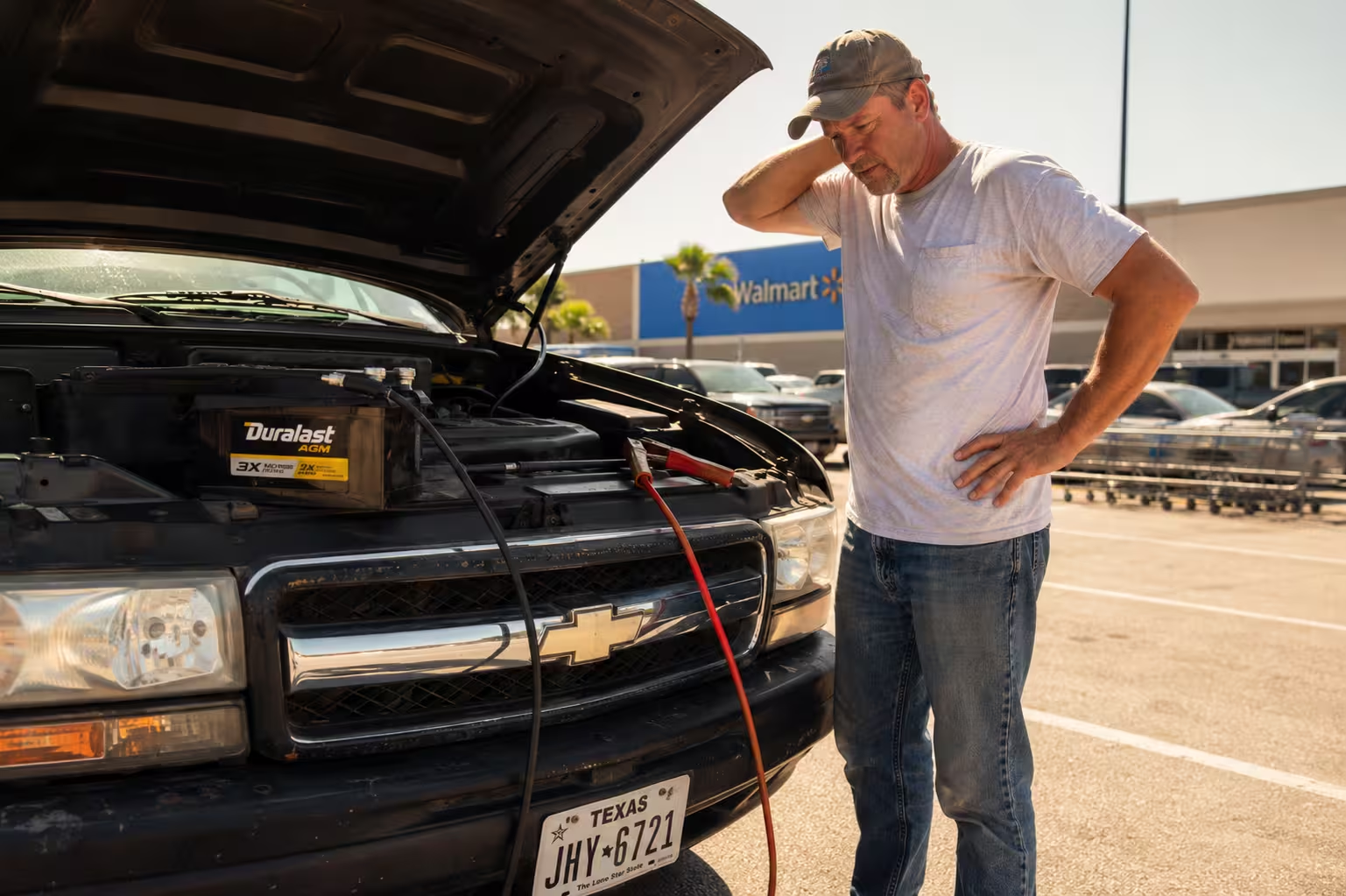
The best time to discover your battery won't survive another Texas summer is in April — not August, stranded in a Walmart parking lot in 105°F heat.
Recondition instead of replacing at the first sign of trouble
A battery reading 12.0–12.3V after a full charge in July is showing sulfation — not death. Battery restoration at home can reverse this for under $15 before it becomes a $200 replacement.
Free Download
The Summer Battery Survival Cheat Sheet
Printable PDF — voltage diagnostic chart, the "Is It Sulfated or Dead?" decision quiz, summer protection checklist, and the 4-step reconditioning readiness test. Everything you need before paying the auto shop.
Free · No spam · Unsubscribe anytime
What American Drivers Are Saying
"Phoenix June, battery dead in a Walmart parking lot. Tow truck quoted $80 just to get to AutoZone. Multimeter read 12.1V — sulfated, not dead. Reconditioned it at home over the weekend. It's been 14 months and counting."
Derek M.
Phoenix, AZ
"Houston summer AC killed my battery in 2.5 years. Shop wanted $220 for a replacement. Used the battery reconditioning guide instead. Restored it in one weekend for $12. Now I test every April before summer hits."
Sandra T.
Houston, TX
"Battery was fine in May. Dead in July. Classic heat sulfation — I just didn't know the term then. Lead acid battery reconditioning brought it back to 80% capacity. Saved me from an unnecessary $180 purchase."
James R.
Dallas, TX
"My mechanic in Atlanta told me the heat destroys batteries every summer here. He was right. But he didn't tell me I could restore it instead of replacing it. The DIY battery restoration process is simpler than I expected."
Patricia L.
Atlanta, GA
Frequently Asked Questions
Why does my car battery keep dying in the summer heat?
Summer heat kills batteries through three simultaneous mechanisms: electrolyte evaporation (the fluid inside the battery boils off, exposing the lead plates), accelerated sulfation (lead sulfate crystals form faster than the alternator can reverse them), and corrosion acceleration on the terminals and internal components. Under-hood temperatures in Texas and Arizona summers regularly exceed 140–200°F — far beyond the 70–80°F optimal range for battery chemistry. AAA confirmed that summer heat, not winter cold, is the #1 cause of battery failure in the USA.
Can I recondition a battery that died in summer heat?
In most cases, yes — if the battery reads above 10V and the root cause is sulfation or electrolyte loss rather than physical damage. Battery reconditioning for heat-damaged lead acid batteries involves a controlled desulfation charge sequence that dissolves hardened lead sulfate crystals and restores electrochemical activity to the plates. A properly reconditioned battery regains 70–85% of its original capacity. The process takes 6–12 hours and costs under $15 in materials. Replacement is necessary only when the battery has a shorted cell (reads below 10V) or has physical damage.
How do I know if my battery is sulfated or actually dead?
Test resting voltage after a full overnight charge. A sulfated battery reads 12.0–12.3V — it has some charge but cannot hold it, because lead sulfate crystal buildup is blocking the plates. A truly dead battery (shorted cell) reads below 10V even after a full charge. These two conditions look identical from the driver's seat — the car won't start — but they have completely different solutions. Sulfation is reversible through DIY battery reconditioning. A shorted cell is not recoverable.
How long does a car battery last in Texas, Arizona, or Florida?
According to Consumer Reports and AAA data, batteries in the hottest southern states last an average of 17 months less than in colder northern climates. In Phoenix, Tucson, and Las Vegas, most batteries last 2.5–3 years. In Houston, Dallas, and San Antonio, 3–3.5 years. In Florida (Tampa, Miami), 2.5–3.5 years depending on proximity to the coast. In northern states with cold winters, the same battery often lasts 4–5 years. Heat, not cold, is the primary factor.
What is the best battery for extreme summer heat in Arizona or Texas?
AGM (Absorbent Glass Mat) batteries perform significantly better in hot climates than standard flooded lead-acid batteries. Because AGM batteries use a sealed glass mat instead of liquid electrolyte, they are not vulnerable to electrolyte evaporation — the primary heat damage mechanism. Brands like Duralast Platinum AGM, Interstate MTX AGM, and Optima YellowTop are frequently recommended for Arizona and Texas drivers. That said, even AGM batteries will eventually suffer heat-accelerated degradation and can benefit from battery reconditioning when performance declines.
Is it safe to recondition a car battery at home?
Yes, with basic safety precautions. Lead acid batteries produce hydrogen gas during charging — work in a ventilated area and keep open flames away. Wear gloves and safety glasses (battery acid is corrosive). The DIY battery reconditioning process itself — the charge and discharge sequence — is safe when the correct protocol is followed for your specific battery type. Flooded lead acid, AGM, deep-cycle, and NiCad batteries each require a different reconditioning sequence. Using the wrong protocol on the wrong battery type can cause damage.
How much can I save by reconditioning instead of replacing a summer-damaged battery?
A standard battery replacement costs $100–$350 installed depending on type, vehicle, and retailer. An AGM replacement runs $150–$350. Battery restoration at home costs $10–$15 in materials. The savings range from $85 to $340 per battery. Applied across the full lifespan of a vehicle — and across multiple batteries (car, truck, motorcycle, golf cart, marine) — drivers who learn the reconditioning process typically save $500–$1,500 over a decade.
Before You Pay the Auto Shop This Summer
Watch the Free Presentation — Then Decide
The free presentation covers the exact battery reconditioning protocol for heat-damaged and sulfated lead acid batteries. If your battery qualifies, you could restore it this weekend for under $15 — instead of paying $150–$350 for a replacement.
Watch The Free Presentation →Free to watch · No credit card · Available right now